The Dealt blog
Notes on hiring, broken.
Why verified credentials matter, what we're building, and how the hiring funnel actually breaks. From the Dealt team.
The fake reference is usually a peer, not a subordinate
Hiring teams often assume a fake reference comes from an obliging junior contact. The data suggests otherwise, and one reference call shows why that assumption is dangerous.
Three out of four resumes never meet a human
ATS software filters an estimated three in four resumes before a human ever sees them. Two recent legal cases, against iTutorGroup and Workday, show how that filtering can replicate discrimination at scale.
What HMRC actually tells an employer, and what it doesn't
UK employers must run right-to-work checks by law, but that's a different check entirely from verifying someone's claimed employment history. Here's what HMRC PAYE records can confirm, and what they can't.
The hire rate fell to one in two hundred
The job hire rate has fallen to roughly one in two hundred applications, while recruiting teams have shrunk and application volume keeps climbing. An honest look at what the math means and how to spend a job search differently.
Companies dropped the degree requirement. They didn't change who they hire.
A Harvard Business School and Burning Glass Institute study found that at some large firms, fewer than 1 in 700 new hires were actual non-college graduates despite dropped degree requirements.
It takes about an hour to build a fake job candidate now
Real-time deepfake tools have gotten good enough that someone with no image-manipulation experience can build a synthetic candidate able to pass a video interview in roughly 70 minutes.
Some of the jobs you're applying to don't exist
Ghost job listings, postings for roles that were already filled or never seriously intended to be filled, are a measured phenomenon rather than paranoia. Here's how common they are and how to spot one.
Your application is one of 242. Here's how to not disappear.
The average job posting now draws about three times as many applications as it did in 2017, which means most resumes get seconds of real attention. Here are six ways to survive that first pass.
How North Korea turned remote IT jobs into a $500 million operation
North Korea runs a documented, ongoing fraud operation that places IT workers in remote roles under false identities, and U.S. prosecutors have already tied it to more than 300 companies.

What 'verified' actually means on Dealt
A "verified" badge is only as good as the verification behind it. Here's exactly what we check, how we check it, and what we don't.

Building proof of work when you're between jobs
Layoffs happen. Sabbaticals happen. The gap on your resume isn't the problem — the lack of evidence during it is.

Why your applications aren't getting callbacks (and what does)
If you're applying and not hearing back, the issue is rarely your CV format. It's usually that nothing on your application can be confirmed in 90 seconds.

ATS vs source: why Greenhouse can't fix your funnel
Your ATS is excellent at managing applicants. It cannot, by design, do anything about the people entering it. That's a different problem with a different fix.

References are dead. Here's what replaces them.
The reference call as we know it is a polite formality that helps no one. Here's what a useful version of it actually looks like.

You don't have a hiring problem. You have a top-of-funnel problem.
Companies obsess over interview loops, ATS workflows, and offer letters. Almost none of those changes will help if the wrong people are entering the funnel in the first place.
The stealth startup problem
Two years at a company you can't name, building something you can't describe. The phrase has a lot of legitimate uses — and a lot of illegitimate ones.

Why we don't call ourselves a discovery platform
Most platforms turn candidates into a searchable list. We chose not to. Here's the reasoning, and what we built instead.
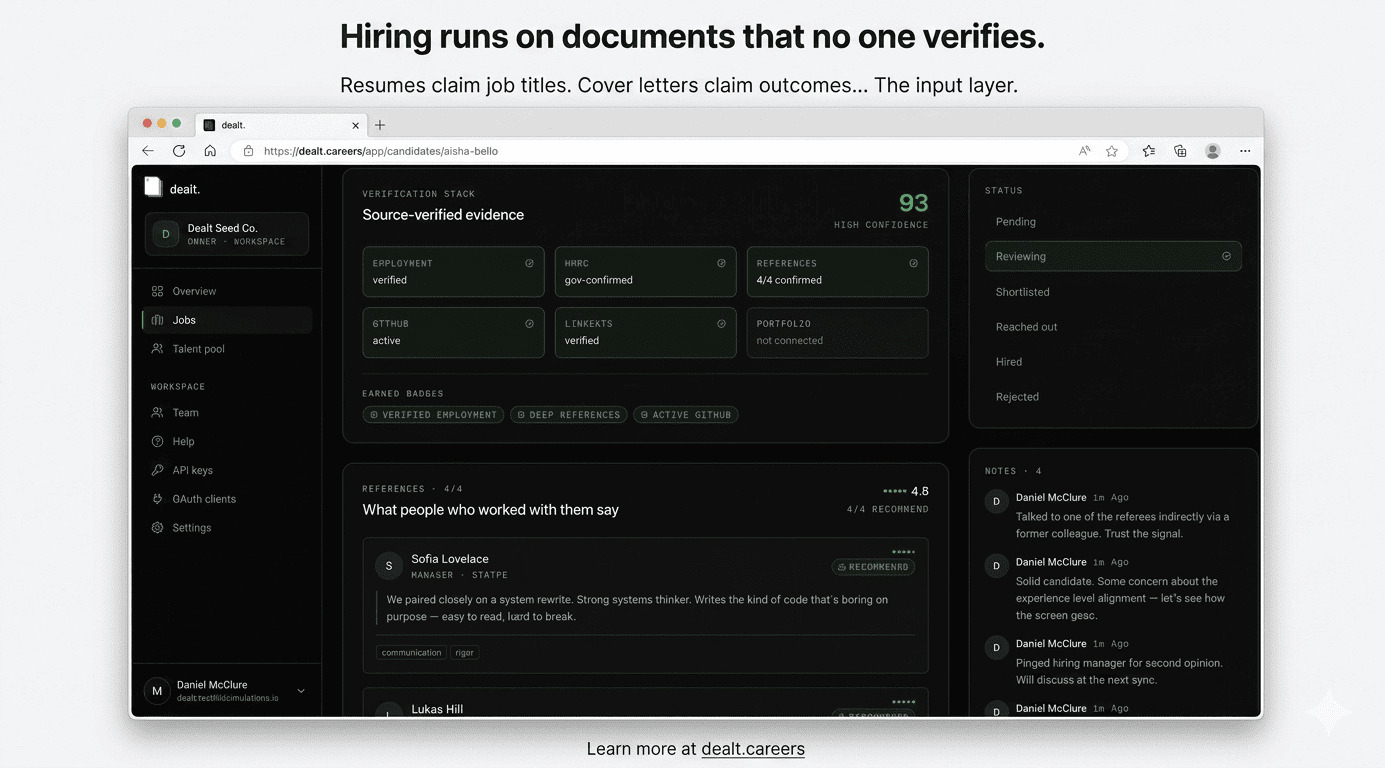
Resume screening is broken. Here's what we're building instead.
We're not optimising the funnel. We're rebuilding what enters it. A short note on why we started Dealt — and the mess we keep tripping over.